META42 Headphone Amplifier
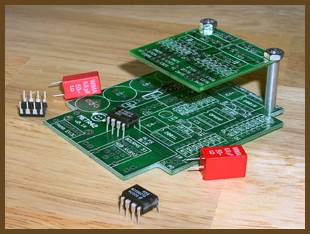
What's a META42?
The META42 was the predecessor to the PIMETA. Its main features were:
Small board size: 2.9" × 2.4" (61mm × 74mm)
The board should work with most FET-input dual-channel op-amps. (Or a pair of single-channel op-amps, with adapters.) DIP and SOIC packages work directly with the board.
Elantec EL2001 or EL2002 buffers on the outputs. These are typically configured in a Jung multiloop topology, but there are other possible topologies.
Strong power supply circuit, for such a small amp: multiple levels of capacitors for reservoir/bypass, lots of space on the board for power caps, virtual ground buffer driven from a precision voltage divider, etc.
Reverse power supply voltage protection
If you use a suitable low-voltage op-amp (e.g. the AD823), minimum supply voltage is 3V on a minimal feature set. A conservative minimum is 6V with all of the features of the board enabled.
The op-amps can be biased into class A.
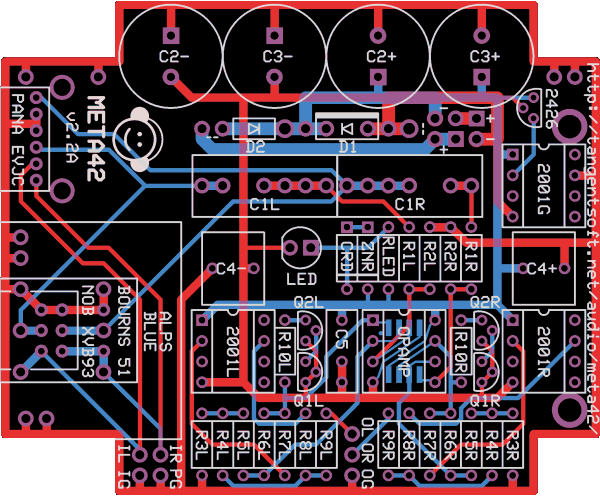
The board will accept several commonly-available volume controls, including the popular, small and cheap Panasonic EVJ potentiometer or the nice, big and expensive ALPS RK27 series potentiometer.
All resistors are on 0.100" × 0.300" spacing. This means that you can put a DIP socket in their place and socket the resistors for easy experimentation. Similarly, many other holes are placed on 0.100" centers to allow the use of socket strips.
It strikes a careful balance between spaciousness for things like large, premium capacitors, while still keeping the board small enough to fit in small, portable cases like the PacTec HML and the Serpac H-65.
The board's layout is optimized for minimum trace length. There are no vias and no layer changes at component pins.
A lot of attention has been paid to usability for the person populating the board.
Several other points of flexibility have been designed into the circuit. We're not expecting that the amp design will be all things to all people, but we'll give it a try anyway. :)
These pages are being left up mainly for historical reasons, as the META42 is a dead end design and no more of the professional boards I made are available. The Elantec EL200x buffers the boards depended on were discontinued. I did make a new version of the META42 with the Burr-Brown BUF634 buffer; that version does work well, and you can download the design files from this site. I abandoned that line of development because I found that changing the topology to be more like that of the PPA gave even better results. The result is the PIMETA.
Where To Next?
Project FAQ — Newbies, start here!
Building the META42 Amplifier: